Nearly half of women say they’re let down by their gifts: Here's how to fix that
Lifestyle

Audio By Carbonatix
10:00 AM on Friday, March 6
By Leslie Albertson for Mixbook, Stacker

Nearly half of women say they’re let down by their gifts: Here's how to fix that
Between all of life’s big moments, so much time is spent hunting for the right gift—usually under the assumption that a bigger price tag is better.
But Mixbook's new study of 1,000 Americans tells a different story. While 90% of people claim the price tag doesn’t matter, nearly half of women (46%) have walked away disappointed by a gift that felt meaningless. It turns out that by focusing on the cost, some might be missing the mark on the connection.
Read on for the heartwarming, the disappointing, and the real financial expectations of gift-giving.
Key takeaways
- Younger adults especially value gifts from their close friends. Fifty-three percent of Gen Zers (ages 18-28) feel appreciated when receiving a gift from a friend, a higher percentage than the 37% of millennials (ages 29-44) or 37% of Gen Xers (ages 45-60).
- Around 90% of people say they don’t care how much their partner, friend, or family member spends on a gift.
- While 92% of people believe the thought is what truly counts, gift-spending expectations remain highest for romantic partners.
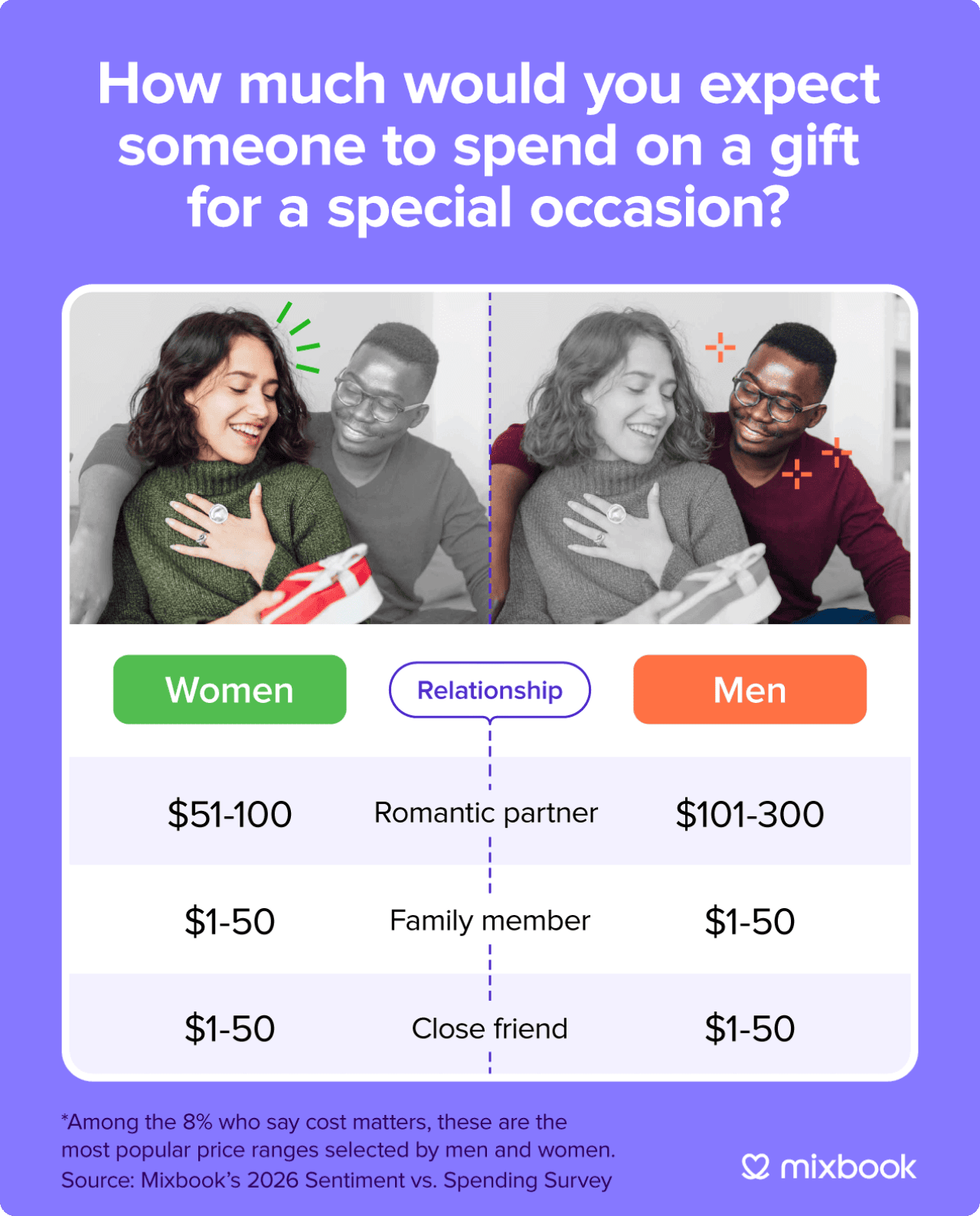
- Among the minority who value price, men expected a slightly higher spend ($101-$300) from their romantic partners than women ($51-$100).
- 46% of women have felt disappointed when receiving a gift because it didn’t feel meaningful or like little thought went into it, compared to only 31% of men.
Nearly half of women and Gen Xers have been let down by gifts that missed the mark
Very little in life is truly universal. The gratitude people feel when getting a gift might be the exception. Nearly everyone (90%) says that they’ve received gifts that made them feel loved and appreciated. That’s true across the board, regardless of gender, race, or age.
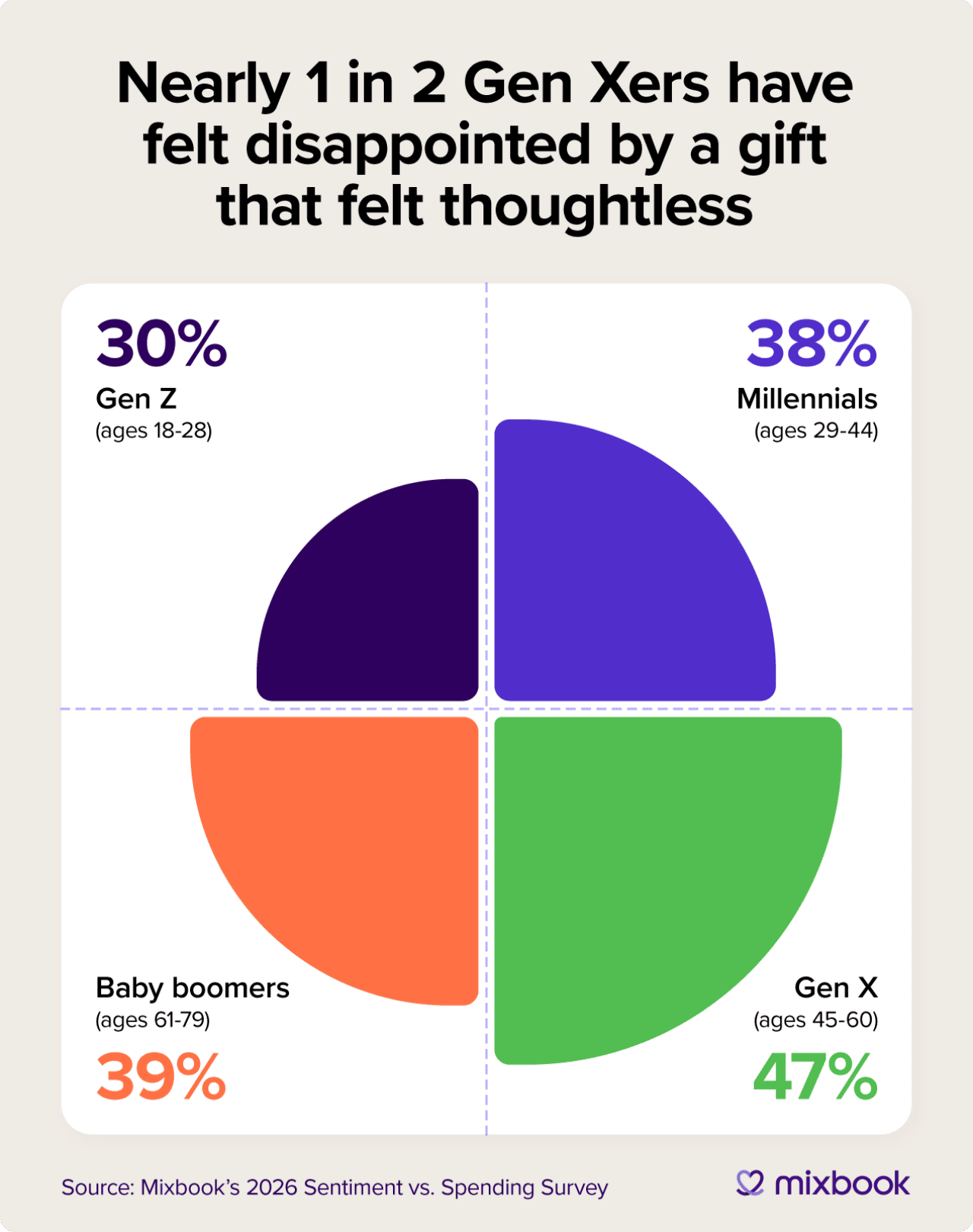
But not every gift is memorable. Nearly 2 in 5 (39%) people say they’ve felt disappointed because they received a gift that felt unmeaningful or like little thought went into it. This is especially true for women and Gen Xers.
According to the survey, nearly half (46%) of women have felt disappointed by a gift, compared to only 31% of men. Similarly, 47% of Gen Xers reported feeling the same, far more than any other generation.
When it comes to what people actually want, the data shows women are most likely to value handmade gifts, like knit items, baked goods, or a handwritten letter. Gen Xers also appreciate homemade touches, though many favor a photo book capturing special memories.
A handwritten letter or note (40%), a photo book filled with special memories (36%), and framed photos (29%) topped the list of sentimental gifts. This shows that the best gifts are often the ones with heart.
Beloved gifts don’t have to come at a high price
No matter who gives the gift, 92% of people say they really do believe it’s the thought that counts.
Among the small share who say cost does matter, expectations are highest for romantic partners. Within this group, the most common expectation is a spend of $51-$100 (33%), followed by $101-$300 (29%).
Looking at gender differences within this same group, the largest share of women (39%) selected the $51-$100 range, while the largest share of men (36%) selected the higher $101-$300 range.
Beyond romantic partners, expectations drop for family members and close friends. Of the people who said cost does matter when receiving a gift, 60% expect family members to spend $50 or less. Expectations are even lower for close friends: 70% expect close friends to spend $50 or less on a gift.
Gen Z values gifts from friends more than any other generation
The best gifts tend to come from people's closest loved ones. That may be why 57% of people say that their romantic partners have given them a gift that made them feel loved and appreciated.
But the people closest to us aren’t always partners. Nearly half (48%) of people say a gift from a parent made them feel appreciated, and 38% say those gifts have come from friends.
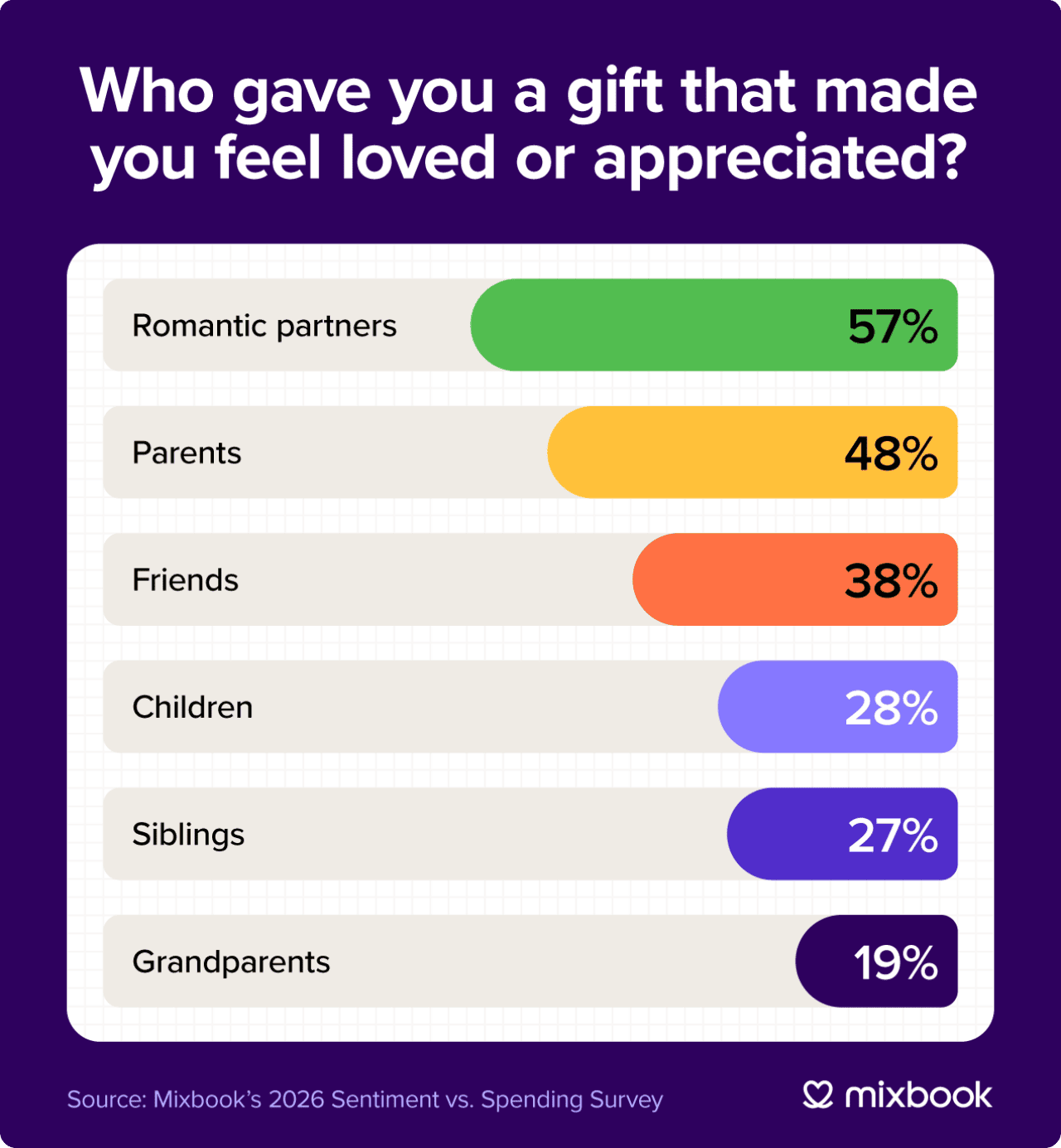
Oftentimes, chosen families (friends, community members, etc.) can be as close as any biological relatives. This is especially true for younger adults: 53% of Gen Zers say they feel loved and appreciated by friends’ gifts, compared to only 37% of both millennials and Gen Xers.
It’s difficult to know exactly why this is true, but relationship trends identified by the Survey Center on American Life provide some insight.
According to its research, younger adults spend more time with friends than other generations and rely on them more for social support. This focus on friendships and social connections could explain why thoughtful gifts resonate so strongly with younger adults.
Methodology
The survey of 1,219 U.S. adults was conducted via YouGov Audience for Mixbook on Dec. 22-23, 2025. Data is weighted, and the margin of error is approximately +/-3% for the overall sample with a 95% confidence level.
This story was produced by Mixbook and reviewed and distributed by Stacker.


