What the Pen Pal Comeback Says about Our Need to Connect
Guest Commentary


Audio By Carbonatix
By Peyton Garland, Crosswalk.com

Key Points
- The renewed interest in pen pals reflects a desire for slower, more intentional forms of communication.
- Scripture repeatedly calls Christians to encourage, comfort, and build one another up.
- Meaningful relationships require time and attention rather than simply frequent communication.
- Vulnerability can help people discover that they are not carrying difficult experiences alone.
- A handwritten letter can become a simple, practical way to encourage someone and remind them that they are worth our time.
I still remember my first pen pal’s name: Isabella. My second-grade teacher coordinated with a second-grade teacher at another school and paired us with our own official pen pal, teaching us the art of written communication. As the year progressed, we got to know our pen pals better. Neat enough, we were able to go on a field trip to meet them.
It was magical; this person I imagined on paper was standing in front of me. She was a delight to play with. Almost thirty years later, my brain still has a fuzzy but decent memory of her long dark hair. I’m certain she was Latina, but an eight-year-old doesn’t discuss ethnicity with a pen pal. She simply calls her a friend and heads onto the playground without any prerequisites.
Though the memory of my 2001-2002 second-grade school year has a vintage feel, the nostalgia of pen pals has made a significant comeback. A recent TikTok call for summer pen pals drew 14,000 sign-ups, part of a growing interest among younger adults in handwritten letters and slower, more intentional communication.
There is a cultural trend that, whether knowingly or not, is desperate and determined to explore our God-given need for meaningful relationships. It’s safe to assume that this need is heightened because we live in a world of constant digital connection. The friends we have and the people we “know” are easily reduced to icons on a screen, little bubbles in the corners of our phones, and chat boxes and usernames that we can keep at a distance.
Meanwhile, Scripture calls Christians to encourage one another, listen well, and invest in relationships that require time and care. This is a personal calling that 1 Thessalonians 5:11 emphasizes: “encourage and comfort one another and build up one another…”
So what happens when believers take the time to rediscover what relationships are meant to be by choosing deeper connection over faster communication?
Why Does Meaningful Communication Require Us to Slow Down?
Though we can certainly encourage each other through social media, cultural context clues leave us no choice but to understand that this call to care for others in 1 Thessalonians is a deeply personal, attached command. Biblical characters had no context, let alone a concept, of a digital world where people could communicate with each other with a few button clicks.
There were no emails, video chats, or text messages. They simply had an ancient form of pen and paper. Individuals had to slow down their days long enough to thoughtfully craft a handwritten message without the aid of emojis or other communicative resources, and trust that the letter would somehow, eventually, reach the intended recipient and be completely and accurately understood.
Then, they would have to wait, for who knows how long, for a reply.
We get flustered when we don’t hear back from someone within an hour, knowing full well the responsibilities they have to family, church, and work. But consider Paul’s willingness to write letters while imprisoned, spreading the gospel no matter how long it took, knowing that he might not receive a response (or at least be allowed to see one) while he was in jail.
Humans quite literally need communication to survive. It’s an emotional, mental, and spiritual tool that we have to keep each other spurred on as we spread the gospel, all while living it to the best of our abilities in a fallen world. Something so precious and necessary requires time, though. Writing letters is a lovely way to convey a specific message that you’ve wanted to share while also saying, “You are worth my time.”
Letters require that you hunt down stationery and pens. It requires you to think through what you’re going to say, one sentence at a time, because there is no backspace or delete button. It requires you to know their address, scrounge up the correct change for a stamp, and carve out time in your schedule to drop it off at the post office.
I’ve learned that there are two things humans often value most: time and money. Sending someone a letter easily requires both. That said, take a few moments to sit down and draft a list of people who could use a letter of encouragement. Pick out 1-2 names per week, month, or quarter, and send them a note of thanks, sympathy, encouragement, celebration, etc.
As Proverbs 15:4 says, “Kind words are good medicine…”
Why Does Deeper Connection Require Vulnerability?
Vulnerable. Most people think this word sounds a bit too gushy, like overkilled lingo in therapy, or they think it’s a bit too intense, requiring a level of trust that feels unsafe. I understand both perspectives, but even when our excuses make sense or feel justified by past experiences with unhealthy, unkind people, we only sell ourselves short by not being open and honest with others.
My three-year-old son was recently diagnosed with Type 1 Diabetes. It has felt like such a blow. It has been a true grieving process to let go of the life my husband and I had planned for him. This new, challenging season has also come with an inconceivable amount of loneliness.
I’ve isolated myself from other moms and avoided their playdate invitations. I didn’t want to be around kids whose pancreases work because it was such a stark reminder that my baby’s doesn’t.
It’s been too easy to shrink from others, but I don’t doubt that God has seen me in my brokenness:
This weekend, after a very hard few days of my son’s glucose levels climbing for an unknown reason, we took him to the park. But we left the house later than we anticipated, and my son didn’t want to play at the city park but at the elementary school playground across the small parking lot. I followed him to the “blue slide!” and noticed another mom with a young daughter.
We smiled at each other and watched our little ones run around. A few minutes later, I noticed the insulin pump on the little girl’s leg. I walked up to her mom and said, “Excuse me, but are you a T1D mom?” She smiled that tired smile and said yes. I told her I was a T1D mom, too.
We stayed at the park for over two hours, talking about our babies’ stories and how this diagnosis has changed our day-to-day lives. Neither of us has a cure for this disease. We know there isn’t an immediate fix. But I walked away from that blue side feeling like the weight of the world had been lifted off my shoulders—all because someone was vulnerable.
How Can Our Words Help Carry Someone Else's Burdens?
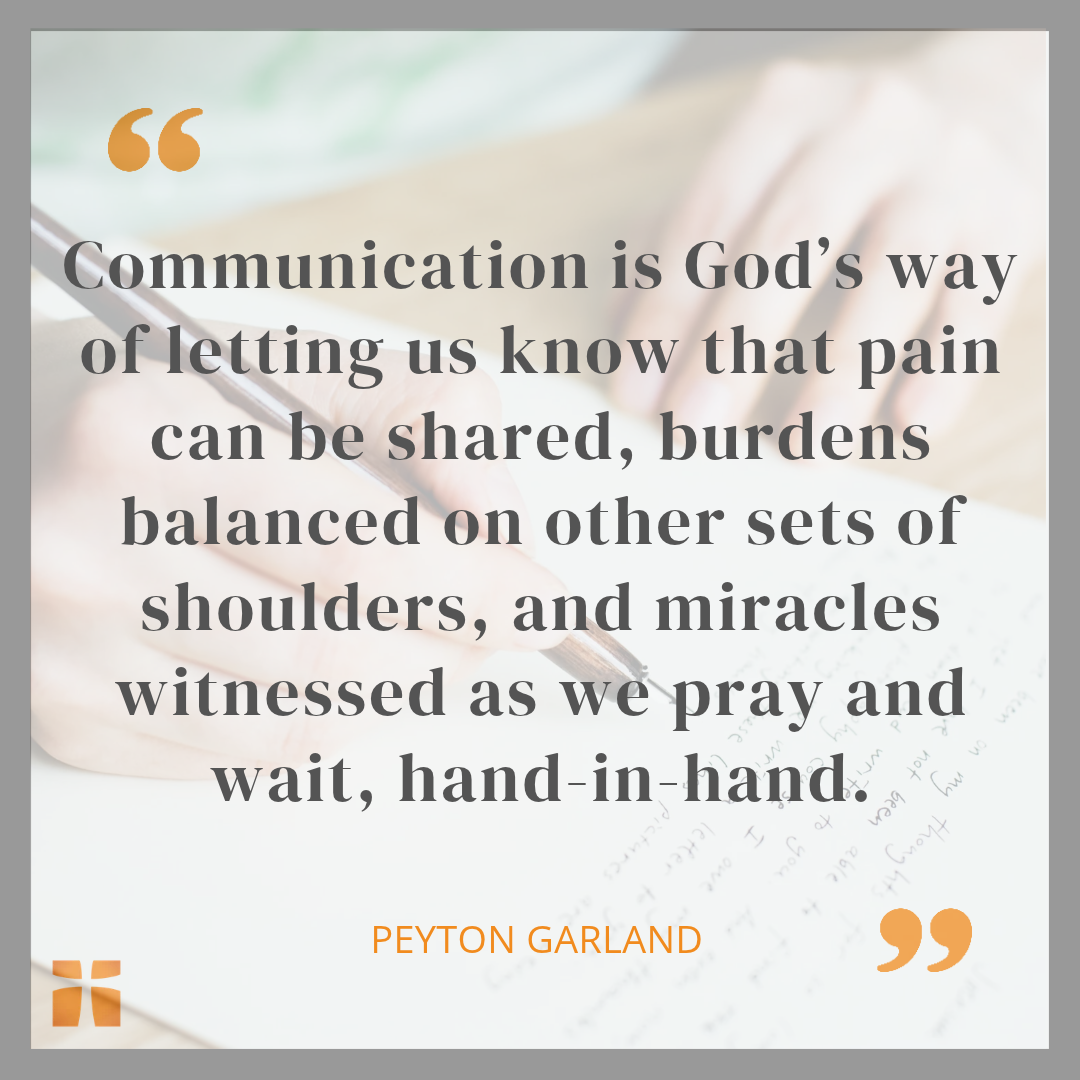
Communication is God’s way of letting us know that pain can be shared, burdens can be balanced on other sets of shoulders, and miracles can be witnessed as we pray and wait, hand in hand.
I encourage you to write that letter, whether to a stranger, pen pal, or friend. Write a thank-you, sympathy, or celebration note. Craft a poem, write song lyrics, attach photos—do all the things that take time. Share a story, whether a victory or a loss, so others know they aren’t alone.
Christ has graciously allowed us to bolster each other’s hope through our words. So choose them patiently, honestly, wisely, and beautifully. And let God change another person’s heart through your pen.
Frequently Asked Questions
Why Are Pen Pals Becoming Popular Again?
Recent interest in pen pals appears to be part of a wider attraction to slower, more personal forms of communication in an increasingly digital world.
What Does the Bible Say about Encouraging One Another?
First Thessalonians 5:11 calls Christians to encourage one another and build each other up, making encouragement an important part of Christian relationships.
Can Writing a Letter Be a Form of Christian Encouragement?
Yes. A thoughtful letter can offer encouragement, gratitude, sympathy, celebration, prayer, or simply remind another person that someone cares enough to spend time communicating with them.
Why Is Vulnerability Important in Christian Relationships?
Healthy vulnerability allows Christians to share struggles, receive encouragement, and help carry one another's burdens instead of facing difficult seasons entirely alone.
How Can Christians Build Deeper Relationships in a Digital World?
Christians can intentionally slow down, listen, spend time together, communicate thoughtfully, share struggles honestly, and look for practical ways to encourage one another.
For Further Reading
- 6 Reasons Community Is Vital in Every Christian Life
- What Does Edification Mean in the Bible?
- 4 Rhythms That Quiet the Soul in a Noisy World
- 5 Ways to Create a Christian Community
- Are We Supposed to Bear Each Other’s Burdens as Galatians 6:2 Says?
Photo Credit: Getty Images/Eerik
 Peyton Garland is an author, editor, and boy mama who lives in the beautiful foothills of East Tennessee. Subscribe to her blog Uncured+Okay for more encouragement.